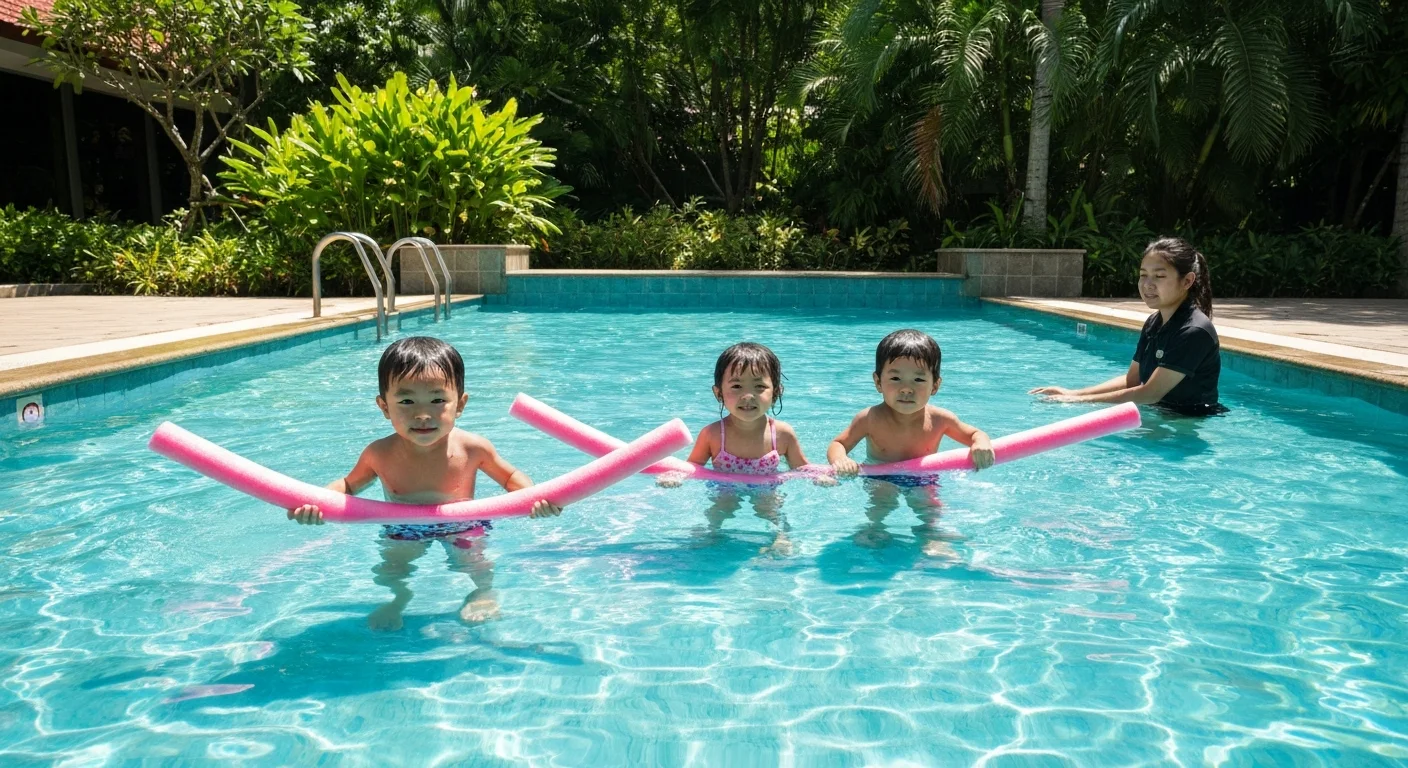
Kids Pool Parties in Singapore
A pool party is one of the most common ways Singapore families celebrate a birthday. The weather is warm year-round, almost every condo has a pool, and kids love water. What most parents underestimate is how quickly things can go wrong when ten over-excited children, a few distracted adults, and a swimming pool combine in one place. Most childhood near-drowning incidents in Singapore happen at home or condo pools during informal gatherings, not at public pools where there are lifeguards.
This guide covers what actually matters for a safe, well-run kids pool party in Singapore: where to host it, how to supervise properly, what activities suit which ages, and the planning details that get forgotten until the day.
Where to Host
Condo and home pools
The default option for most families. Free, familiar, and convenient. The trade-off is zero professional supervision. If you host at your own pool, you are the lifeguard, and that means a sober adult whose only job is watching the water for the entire duration of the party. Realistically, you cannot also host the party. Either get a co-host who handles the food and the cake while you watch, or hire a freelance lifeguard for the day.
Public swimming complexes
ActiveSG swimming complexes have lifeguards on duty during operating hours. They are inexpensive, but you cannot reserve a private area, you cannot bring large amounts of food onto the deck, and the pools are open to the general public. Best for smaller, low-key gatherings rather than full birthday parties. See our guide to public swimming complexes for the full list.
Private swim schools and party venues
Several swim schools and recreation venues in Singapore offer dedicated party packages. These typically include a private use of a teaching pool, instructors acting as supervisors, structured games or activities, and sometimes catering. They cost the most but solve the supervision problem entirely. For a party of children who do not all swim well, this is often the safest option.
Hotel pools
Some hotels offer day-pass or function packages that include pool access. This is workable for families with the budget, particularly hotels with shallower family-friendly pool areas.
Supervision: the Numbers That Matter
Here are the supervision ratios that work in practice for an unstaffed pool party. These are conservative because parties are loud, busy, and distraction-heavy.
- Children under 5 or non-swimmers of any age: one adult per two children, in the water, within arm's reach
- Children 5 to 8 with basic swimming ability: one adult per four children, on the deck and watching constantly
- Children 9 and up with confirmed swimming ability: one designated adult per six children, on the deck
"Designated" is the important word. It is not enough to say "the parents are around". At any given moment, one specific adult must know that they are the watcher and that they are not doing anything else. Rotate the role every 20 to 30 minutes so the watcher does not zone out. The "everyone is watching, so nobody is watching" failure pattern is what causes most near-drownings at parties.
Confiscate the watcher's phone if you have to. A drowning toddler does not splash or shout the way they do in films. They go under silently, sometimes within metres of an adult who is looking at a screen.
Age-Appropriate Activities
Match the games to the youngest non-swimmer present, not the oldest confident swimmer. Water games that suit older kids can put younger ones in over their heads, literally.
Ages 3 to 5 (toddlers and pre-schoolers)
- Floating toys and pool noodles in the shallow end
- Splash games with cups and watering cans
- Marco Polo with parents in the water
- Treasure hunt with sinkable toys, only in water the child can stand in safely
Ages 6 to 9 (early swimmers)
- Pool noodle races across the width
- Diving for rings in shallow water (depth they can stand in)
- Beach ball volley over a rope or pool divider
- Simple relays
Ages 10 and up (confident swimmers)
- Length races, with adult judging at the wall
- Underwater swim challenges (no holding under, no hyperventilation games)
- Water polo or modified ball games
- Diving or jumping competitions, only in water deep enough and only with adult supervision
Activities to Avoid
Some games look like fun but cause real harm. Skip these regardless of age:
- Breath-holding contests and shallow water blackout games. These have killed otherwise strong swimmers, including teenagers and adults. Hyperventilating before submersion suppresses the urge to breathe and can cause loss of consciousness underwater. Never allow.
- Holding or pushing kids underwater "for fun". Even brief involuntary submersion can cause panic, water inhalation, or worse.
- Chicken fights and shoulder-riding games. Common cause of head injuries when someone gets tipped backwards.
- Diving into shallow water. Diving requires depth. The teaching pool and the wading pool are not for diving.
- Inflatable bouncers in the pool. Children can get trapped underneath. If there is one at the party, an adult must be watching it constantly.
What to Bring
- First aid kit. Plasters, antiseptic, sting cream, ice packs. Parties involve scrapes.
- Towels. More than you think. A wet child gets cold quickly even in Singapore.
- Sun cover for outdoor pools. Sunscreen for everyone, plus a tent, umbrella, or shaded area for the cake and food. The midday Singapore sun on a wet child is an ambush.
- Water and food on a separate area away from the pool edge. Glass is a hazard, food in the pool spoils the water, and a wet child running with a paper plate is one slip away from a fall.
- Whistle. Small detail, big effect. The designated watcher carries a whistle and uses it to halt activity for an emergency or just to get attention. Voices get lost in pool noise.
- Phone numbers for parents. If a child needs to be sent home or have a parent called, you do not want to be searching through chat groups.
The Hour Before Guests Arrive
A short walkthrough before the party catches the issues that cause most incidents:
- Walk the pool deck. Move anything slippery. Mop standing water at corners.
- Check pool gates and fences. Self-closing. Unjammed. Latched.
- Check that floatation devices are in the pool area, including a rescue ring or pole if available.
- Brief any other adults: "You are watching from 2pm to 2:30pm." Make the rotation explicit.
- Decide the rule for how children enter and leave the water. A simple "ask before getting in" rule prevents kids slipping in unnoticed.
- Identify any non-swimmers in the guest list before they arrive. They wear armbands or stay in the wading area, supervised.
What to Do If Something Goes Wrong
Have a plan before you need it.
- If a child is in distress in the water, do not jump in unless you are a competent swimmer. Reach with a pole or noodle, throw a flotation device, or shout for someone who can swim.
- Pull the child out and check breathing. If they are coughing and crying, they are breathing. Comfort them, watch them for the next hour.
- If they are not breathing or are unconscious, call 995 immediately and start CPR if you are trained. Singapore Civil Defence Force ambulance response in residential areas is fast.
- "Dry drowning" and "secondary drowning" are widely misunderstood terms. Genuine delayed drowning is rare. But any child who has had a serious water-inhalation incident should be assessed by a doctor that day.
The Honest Bottom Line
Most kids pool parties in Singapore go fine. The ones that do not go fine have a common pattern: too many children, too few committed watchers, alcohol on the deck, and a moment of distraction. None of these are unfixable. A pool party with one sober designated watcher per group of children, no breath-holding games, and a clear pre-party walkthrough is dramatically safer than the default version most families default to.
Swimming ability helps, but supervision is what saves children. Plan the party as if every child were a non-swimmer, and you will catch the trouble before it starts. For more on water safety with children, see our guide on water safety for kids in Singapore.