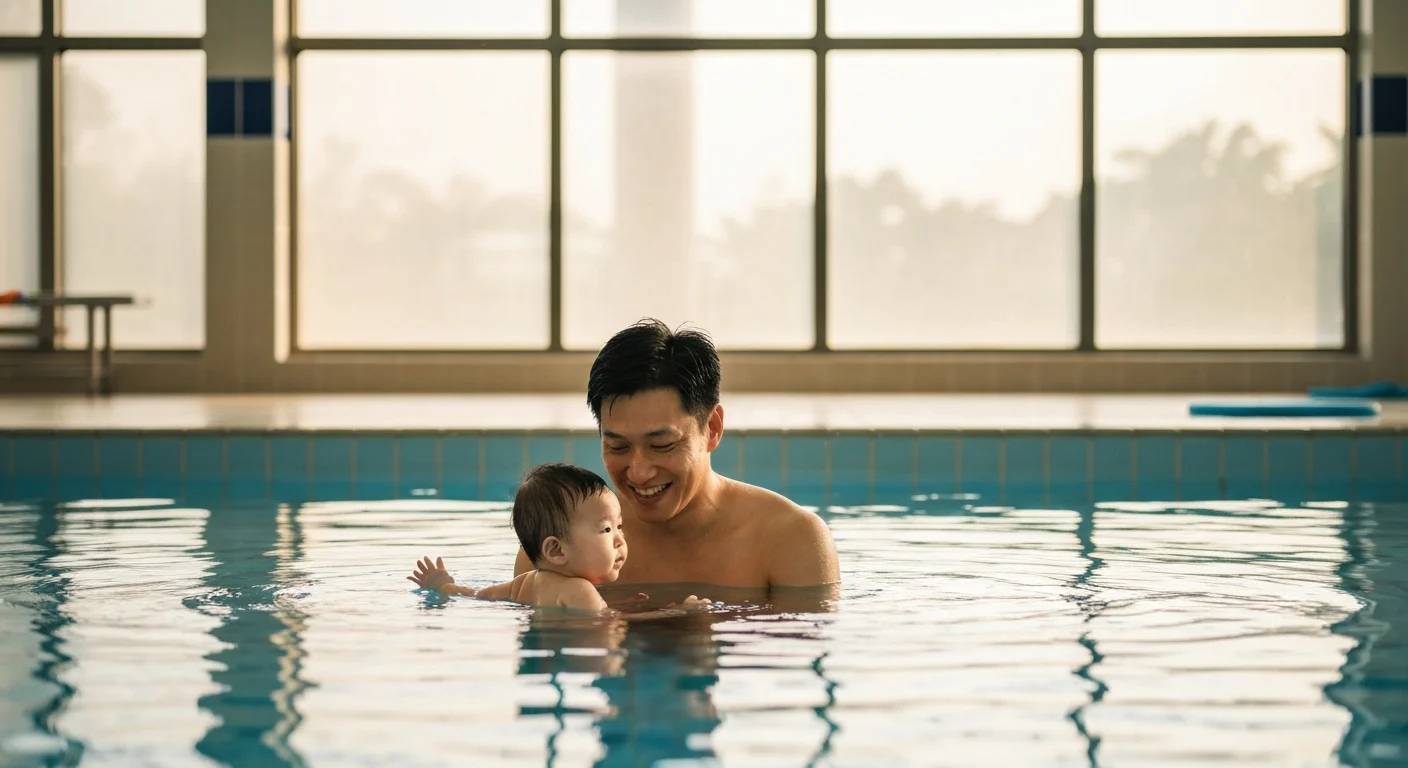
Baby and Toddler Swimming in Singapore
If you are a Singapore parent searching for "swimming classes for toddlers" or "infant swim lessons", you are probably hoping for two things: that your child will be safer around water, and that they will eventually learn to swim. Both are reasonable goals. But baby and toddler swim programmes do not work the way most parents assume, and the gap between expectation and reality is where families end up frustrated, overspending, or putting infants in environments they should not be in yet.
This guide explains what baby and toddler swimming actually involves at each age, what to look for in a class, what to ignore, and what is realistic to expect. It is written for Singapore conditions, where pools are warm year-round, public facilities are excellent, and a small but specialised market of infant-aquatic providers operates alongside the mainstream swim school industry.
When Can a Baby Start Swimming?
The honest answer: babies cannot swim. What babies can do is learn to be comfortable in water, develop water familiarity, and build a positive relationship with submersion before fear sets in. That is the actual goal of "infant swim" programmes, regardless of how they are marketed.
Here are the meaningful age windows used by paediatricians and swim educators internationally, applied to the Singapore context.
0 to 6 months
Most paediatricians recommend waiting until at least 6 months before formal classes. The reasons are practical: a newborn cannot regulate body temperature well, chlorinated water can irritate sensitive skin and the umbilical area, and the immune system is still developing. Babies under 6 months also cannot hold their heads up consistently, which limits what is possible in the water.
If you want to introduce a very young baby to water, the bath is a perfectly good starting point. Warm bath water, skin contact with a parent, gentle pouring of water over the head and body, and lots of eye contact builds the same comfort that an expensive class would.
6 to 12 months
This is the earliest reasonable age for formal "parent and baby" water classes. At this age, your baby can hold their head up, has had their first round of vaccinations, and can tolerate the temperature of a heated teaching pool. Sessions are short, usually 20 to 30 minutes, and involve the parent in the water at all times. The activities are simple: floating with support, gentle splashing, songs, basic submersion under controlled conditions, and getting used to the sensation of water on the face and ears.
What your baby is learning is not swimming. It is sensory familiarity and trust. Done well, this builds a child who is not afraid of water, which is the foundation everything else rests on.
1 to 2 years
This is the most common starting age for Singapore parents. Toddlers at this stage can follow simple instructions, walk, hold onto pool edges, and tolerate longer sessions. The class structure is still parent-and-child, and the activities expand: kicking with a kickboard, blowing bubbles in the water, brief independent floats with the instructor's support, climbing in and out of the pool safely, and simple breath-holding games.
Realistic expectation: your 18-month-old is not going to swim a length. They are learning to be a confident, comfortable, safe-around-water toddler. That is enough.
2 to 3 years
Most swim schools in Singapore start accepting children for proper grouped lessons from around 2.5 to 3 years old. By this age, the child can usually follow a structured class without a parent in the water, attempt assisted floats, and begin learning the building blocks of stroke technique. Independent locomotion (a few unsupported metres) can happen for some children at this stage, but it varies enormously by temperament and water exposure history.
3 to 4 years
This is when "real" swim lessons begin to look like what most parents imagine. Children of this age can usually hold a streamline position, kick with a board, attempt short distances unaided, and begin learning structured progressions. Many Singapore children at this age are ready to start the SwimSafer national programme through a registered provider.
The Difference Between Baby Aqua Therapy, Infant Swim, and Toddler Swim
These terms get used interchangeably, which causes confusion. Here is what they actually mean.
Baby aqua therapy
A specialised programme typically delivered by physiotherapists or trained therapists for babies with specific developmental, neurological, or physical needs. The water is warmer than a standard pool, sessions are one-on-one, and the goal is therapeutic rather than recreational. Cost is significantly higher than a regular class because of the medical specialisation involved. If your child has been referred by a paediatrician or therapist, this is what they mean.
Infant swim or "parent and baby"
Group or small-group classes for babies aged roughly 6 to 18 months, with a parent in the water. The focus is water familiarity and gentle skill-building. Most major Singapore swim schools and some private operators offer these. Sessions are typically once a week.
Infant Self-Rescue programmes
A different category of training, originally developed in the United States, that focuses on teaching very young children (some from around 6 months) to roll onto their backs, float, and survive an accidental fall into water. These programmes are intensive, usually run as daily 10-minute sessions over several weeks, and are not the same as recreational infant swim. Whether to use this approach is a parental choice and an active topic of debate in the international swim education community. If you are considering it, talk to a paediatrician first, and only use a properly certified instructor.
Toddler swim lessons
Group or small-group classes for children roughly 18 months to 3 years, with progressively less parent involvement. The structure starts to resemble traditional swim lessons but at a developmentally appropriate pace.
What to Look For in a Class
Whatever age you start, the quality of the class matters more than the brand or the marketing. Things to check:
- Pool temperature. For infants and very young toddlers, the water should be at least 32 degrees Celsius. Standard public lap pools in Singapore run cooler, around 27 to 28 degrees, which is uncomfortable for a baby. Look for a dedicated teaching pool or warm pool.
- Class size. For under-twos, no more than 6 to 8 babies in a parent-and-baby session. Smaller is better. For toddlers in independent classes, no more than 4 to 6 children per instructor.
- Instructor credentials. Ask what qualification the instructor holds and whether it includes a specific infant or early childhood module. Generic adult swim teaching qualifications are not enough for under-fives.
- Hygiene. Babies who are not yet toilet-trained must wear a swim nappy. Reputable classes enforce this strictly. Pools that do not are unsafe.
- Approach to submersion. Forced submersion of a screaming baby is not a good practice and is no longer accepted in mainstream infant aquatics. A good instructor reads the child and works at the child's pace.
- What happens after a fearful experience. If a child has a difficult moment in the water, does the instructor pause, comfort, and rebuild trust, or push through? The first answer is the right one.
Safety: What Singapore Parents Should Know
Putting any infant or toddler in water carries some real considerations specific to Singapore conditions.
- Chlorine and skin. Singapore tap water is chlorinated, and pool water is more so. Babies with eczema or sensitive skin should be rinsed off thoroughly after every session and moisturised. Some parents use barrier creams before swimming.
- Ear infections. Common in young children who swim regularly. Drying the ears gently after every session helps. If there is recurring discomfort, see a paediatrician.
- Water swallowing. Babies will swallow some water. In normal amounts this is harmless, but excessive water intake during repeated submersions can be dangerous. A good class structure prevents this.
- Active supervision is non-negotiable. A baby or toddler in the water needs an adult within arm's reach at all times, no exceptions. Read more in our guide on water safety for children in Singapore.
- The "drown-proofing" myth. No amount of infant swim training makes a child safe around water unsupervised. Research is clear on this. Lessons help, but they do not replace adult supervision. Treat any provider who claims otherwise with suspicion.
Realistic Expectations and Costs
Cost in Singapore varies widely. Group parent-and-baby sessions at mainstream swim schools typically run from $30 to $50 per session, often sold as packages of 8 to 12 sessions. Specialist infant aquatics providers and one-on-one sessions can cost $80 to $150+ per session. Aqua therapy with a trained therapist sits at the higher end of that range.
What you should expect after six months of weekly sessions for a one-year-old: a child who is happy in the water, can hold their breath briefly when prompted, can float on their back with support, and is comfortable having water on their face. That is a meaningful outcome and a strong foundation for later swim lessons.
What you should not expect: a one-year-old who can swim. Or a two-year-old. Or, in most cases, a three-year-old.
When to Move Into Structured Lessons
Most children are ready to begin structured group swim lessons (without a parent in the water) somewhere between 2.5 and 4 years old. The trigger is usually a combination of physical readiness, attention span, and emotional comfort with the instructor and the pool. There is no magic age. A confident 2.5-year-old can do well in a well-run small-group class. A reluctant 4-year-old may need another year of parent-led pool time first.
Once they are ready, the next step in Singapore is usually the SwimSafer national programme, taught either through a private swim school or, for primary school children, as part of the school PE curriculum. SwimSafer Stage 1 is the formal starting point. Read more about the SwimSafer programme on the official site.
Where to Find Classes in Singapore
Most private swim schools offer parent-and-baby and toddler classes at heated teaching pools across the island. The mainstream swim school operators run large teacher rosters and standardised curricula. Specialist infant-aquatics providers offer smaller-group, more intensive programmes for parents who want a particular methodology. Aqua therapy is best accessed through paediatrician referral.
For finding swim schools and lesson providers, SingaporeSwimming.com is the main directory. For pool locations and opening hours, SwimmingComplex.com has the full list of public swimming complexes.
The Honest Summary
Putting your baby in the water can be a genuinely positive experience. It builds water comfort, gives parent and child shared time, and lays the groundwork for proper swim lessons later. But the marketing language around infant swim programmes oversells what is actually happening. Your baby is not learning to swim. Your baby is learning to feel safe in the water, while you, the parent, are learning to handle them confidently. That is the real outcome, and it is enough.
Start when your child is developmentally ready, choose a class with warm water and a sensible instructor, and do not pay extra for promises that are not biologically possible at the age you are paying for them. Then enjoy the time in the pool, because pool time with a small child in Singapore is one of the better small luxuries this country offers.