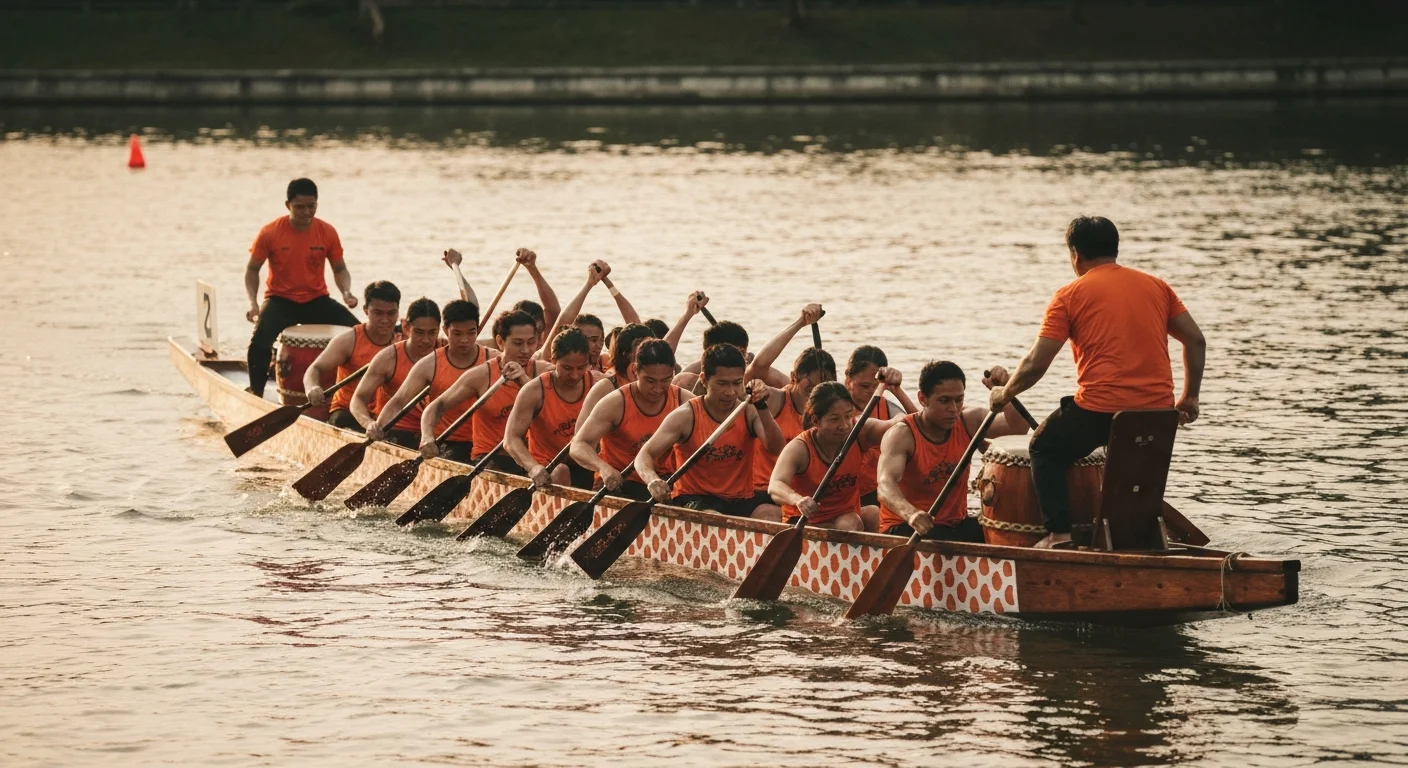
Dragon Boat in Singapore: A Complete Guide to the Sport, Clubs, and Races
Dragon boat is one of Singapore's most active community sports. On any given Saturday, you can watch crews of 20 paddlers syncing strokes across Bedok Reservoir, Jurong Lake, or Marina Reservoir. It is a competitive sport with a well-organised national governing body, and also a recreational team sport that companies, schools, and clubs join for the camaraderie as much as the racing. You do not need to be a strong swimmer to try it (though you should be comfortable in water). You do not need your own gear. Clubs are generally welcoming to newcomers.
This guide covers how dragon boat works in Singapore, who governs the sport, where to paddle, the main annual races, and how to join a club. Facts come from the Singapore Dragon Boat Association (SDBA) and the PAssion Wave public outlet network.
What dragon boat is
A dragon boat is a long, narrow canoe-style boat paddled by a crew of 10 or 20, plus a drummer at the front and a steerer (sweep) at the back. Paddlers sit in pairs on benches and use single-blade paddles, timing their strokes to the drummer's beat. The prow is usually a carved dragon head and the stern a dragon tail. The sport originated in southern China around 2,000 years ago.
Races are run over 200m, 500m, and 1,000m, with 500m the standard international race distance. A crew of 20 is fastest over 500m. A crew of 10 is often used for shorter sprint races. There are men's, women's, and mixed categories, plus youth and masters (40+) age divisions.
At its best, dragon boat looks and feels like a single organism moving across the water. Getting to that level takes regular training as a crew. The technique is individually simple but collectively demanding.
Singapore Dragon Boat Association
The Singapore Dragon Boat Association (SDBA) is the National Sports Association (NSA) for dragon boat in Singapore. It sits under Sport Singapore and represents the country in regional and international competition.
- Address: c/o Sport Singapore, 3 Stadium Drive, #01-33, Singapore 397630
- Email: admin@sdba.org.sg
- Website: sdba.org.sg
SDBA runs the national competitive calendar, selects the national team for international events (SEA Games, Asian Games, World Championships), runs certification programmes for officials and coaches, and handles Safe Sport compliance for the sport nationally. Clubs affiliate with SDBA to compete in national races.
Where to paddle
Dragon boat in Singapore happens at a handful of specific venues, all large enough to take the 12-metre-plus boats and their turning circles.
Water Sports Centre (Kallang)
The primary venue for national-level SDBA races. At Kallang Basin, it hosts the Dragon Boat Sprint, National Inter-School Championship, and Singapore Regatta Waterfest. Open water, sheltered basin.
Marina Reservoir
Used for longer-distance racing, including the SDBA-AustCham 10km Challenge. Also a training venue for several clubs. Accessible from Marina Bay.
Bedok Reservoir
A major training and recreational venue. The PAssion Wave outlet here rents dragon boats and runs community paddling sessions. Hosts the Singapore Dragon Boat Festival in June.
Jurong Lake
Training venue and race location for the SDBA Century Race (March). PAssion Wave @ Jurong Lake Gardens offers dragon boat rental and training.
Other venues
Several PAssion Wave outlets have dragon boat facilities and host community paddling sessions. Private dragon boat clubs also train at various reservoir and bay locations.
The main races
The Singapore dragon boat calendar has several flagship events across the year. Confirm dates for the current year on the SDBA website. The recurring pattern is:
- SDBA Century Race. March, Jurong Lake. Long-distance format, emphasis on endurance
- Singapore Dragon Boat Festival. June, Bedok Reservoir. Traditional festival tied to the Duanwu Festival calendar, with competitive and community paddling categories
- One Paddle North East. June, PAssion Wave @ Bedok Reservoir. Community-focused event for dragon boat across the North East district
- Dragon Boat Sprint @ The Kallang. May, Water Sports Centre. Main sprint-format competition of the year
- National Inter-School Dragon Boat Competition. May, Water Sports Centre. Schools-level competition across secondary schools, junior colleges, and universities
- SDBA-AustCham 10km Challenge. October, Marina Reservoir. Long-distance challenge open to club and corporate teams
- Singapore Regatta Waterfest. November, Water Sports Centre. Year-end regatta combining dragon boat with related water sports
Most races have categories for competitive clubs, corporate teams, and community crews. If your company has a dragon boat team, there is likely a tournament on this calendar that fits.
How to join a club
Singapore has an active club scene across recreational, corporate, and competitive levels. Typical paths in:
Community clubs via PAssion Wave
PAssion Wave outlets at Bedok Reservoir, Marina Bay, and Jurong Lake Gardens run regular community dragon boat sessions open to the public. The easiest way to try the sport without joining a private club. Equipment provided.
Corporate teams
Many multinational corporations and local companies in Singapore keep dragon boat teams for the SDBA races. If your employer has one, join it. Training is usually subsidised and the social side is usually strong.
Private dragon boat clubs
Singapore has a number of established private dragon boat clubs with regular training schedules, competitive calendars, and open tryouts. Examples include various national team feeder clubs and community-affiliated teams. Clubs list contact details on their own websites and social media. Tryouts run a few times a year.
School and university teams
Most universities (NUS, NTU, SMU, SUTD, SIT, SUSS) and several junior colleges run competitive dragon boat teams. Open trials each academic year.
National Team pathway
For advanced paddlers aiming at national representation, SDBA runs selection trials for the national squad. These are publicised on the association's website. The national team competes at SEA Games, Asian Games, and World Championships.
What training looks like
A typical dragon boat training session:
- Warm-up on land. Stretching, shoulder mobility, core activation. 10 to 15 minutes
- Technique drills on the boat. Entry catch, reach, body rotation, exit. Usually without full power, to calibrate form
- Interval sets. Short hard efforts (200m to 500m) spaced with recovery paddling. Builds race pace
- Endurance paddle. Sustained effort at moderate pace for 2,000m to 5,000m. Builds the aerobic base
- Cool-down. Light paddle back to the dock, stretching
Total session length is usually 90 to 120 minutes on the water. Competitive clubs train 2 to 4 times per week, with additional land-based strength and conditioning. Recreational clubs train once or twice a week, often on Saturday mornings.
First-timers are not expected to keep up with the full training intensity. Experienced paddlers in the boat will drop the tempo for new crew members during technique phases.
Positions in a boat
- Drummer (front). Sets the stroke rate with a drum, calls race commands, motivates the crew. Does not paddle
- Pacers (rows 1-2). Set the physical rhythm. The rest of the boat times its strokes to them. Usually technical, lighter paddlers
- Engine room (middle rows). Where the strongest, heaviest paddlers sit. Raw power
- Rockets (rows 9-10). Technical power paddlers who hold form at high stroke rates
- Sweep/helm (back). Steers the boat with a long oar. Does not paddle. Responsible for safety on the water
New paddlers usually start in the engine room (middle), where form matters less than consistent effort. As technique improves, paddlers move toward the front or back depending on their strengths.
Who does well at it
Dragon boat rewards a specific mix of attributes.
- Upper body strength. You pull against water for 2 to 4 minutes at a time in a race
- Aerobic fitness. 500m races are roughly 2-minute maximum-effort events. You need the engine for that
- Timing. The boat moves efficiently only when all paddles enter and exit the water together. Rhythm matters more than raw power
- Team mindset. Nobody wins alone in a dragon boat. Paddlers who over-power and break the timing actually slow the boat down
- Basic swimming ability. You should be comfortable in water, even though capsizes are rare. Life vests are provided
The sport is open at a wide range of fitness levels. Recreational paddlers can train a few times a month and enjoy the social side. Competitive paddlers often have athletic backgrounds. Former swimmers, rowers, rugby players, and runners commonly transition in.
Honest summary
Dragon boat is one of the best team water sports to try in Singapore. Start with a PAssion Wave community session at Bedok Reservoir or Marina Bay to see if you like the feel. If you want to compete, join a corporate team, a private club, or a university team depending on where you are in life. The SDBA calendar has a race for every level, from community festivals to national championships.
You do not need gear. You do not need prior experience. You do not need to be a strong swimmer (just comfortable in water). You do need to be willing to learn timing with 9 other people. That is the one non-obvious skill the sport actually requires.
For other paddle sports, see our kayaking guide. For competitive crossover from swimming, see competitive swimming in Singapore.