Backstroke Technique: A Complete Guide
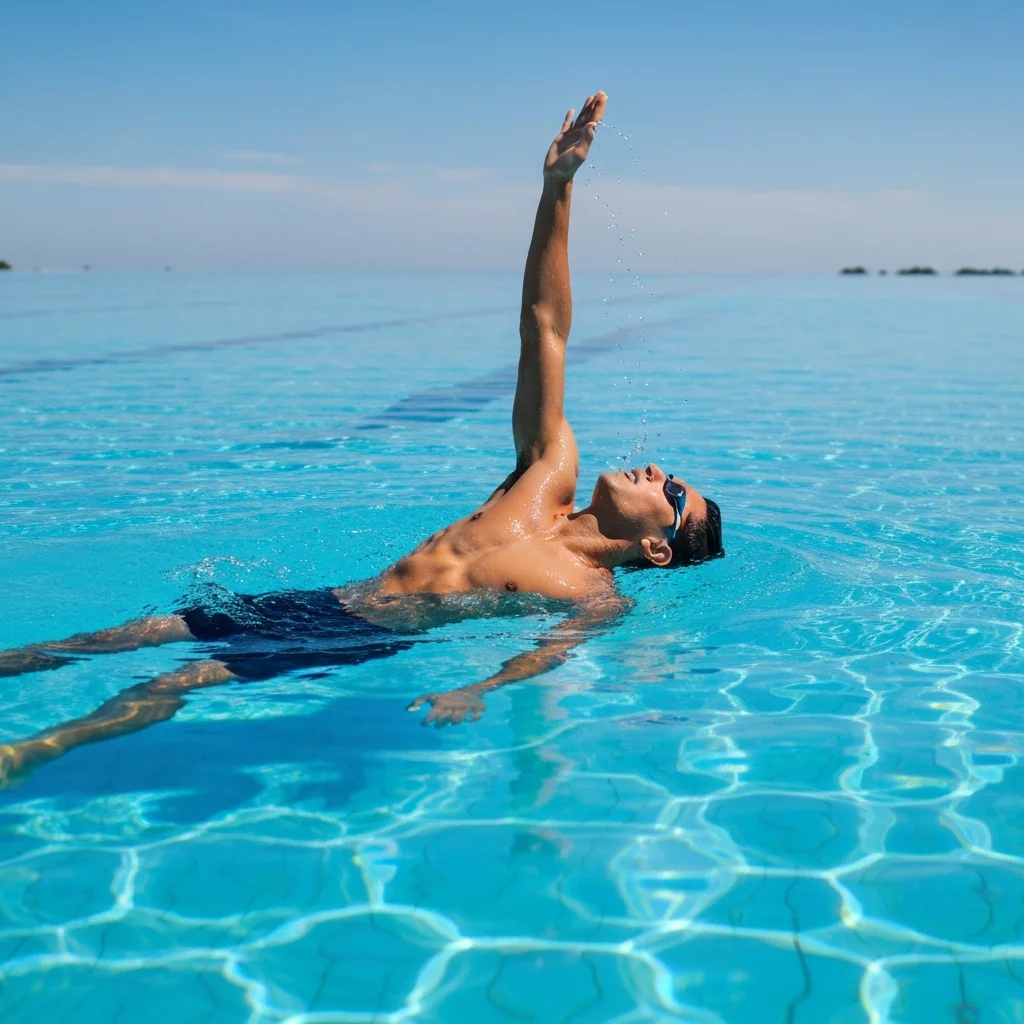
Backstroke is the only competitive stroke swum on your back, which makes breathing easy but navigation tricky. It's also one of the best strokes for posture: the movement opens up your chest and shoulders, making it a natural counterbalance to hours spent hunched over a desk or phone.
The technique shares more with freestyle than most people realise. The kick is identical, the body rotation is similar, and the alternating arm pull follows the same principles. If you can swim freestyle, you already have the foundations for backstroke.
Body Position
A good backstroke position keeps you high in the water with minimal drag.
- Lie on your back, face up. Your head should be still and neutral, as if resting on a pillow. Look straight up at the ceiling (or sky). Tucking your chin drops your hips; tilting your head back causes water to wash over your face.
- Hips high. Press your chest slightly upward to keep your hips near the surface. If your hips and legs sink, you're essentially dragging your lower body through the water.
- Ears in the water. The waterline should sit around your ears. If water keeps going over your face, your head is too low. If your neck is straining, your head is too high.
- Body rotation. Like freestyle, backstroke involves a 30 to 40 degree rotation to each side, driven by the hips. This lets you engage your core and back muscles in the pull, rather than relying on your shoulders alone.
Drill: Balance Kick
Kick on your back with both arms at your sides. Focus on keeping your hips at the surface and your head still. If water keeps washing over your face, adjust your head position until you find the spot where the water sits calmly around your ears. This drill isolates body position without the complexity of the arm stroke.
The Arm Pull
The backstroke pull has three phases: entry, pull, and recovery.
1. Entry
Your arm enters the water pinky-finger first, fully extended, in line with your shoulder. Don't reach across the centreline of your body (causes snaking) or too wide (reduces power). As your hand enters, your body should be rotated toward that side.
2. Pull
Bend your elbow and pull your hand down and back, keeping your elbow pointing toward the pool floor. Your hand traces a path along the side of your body, finishing near your hip. The pull should accelerate through the stroke, fastest at the end.
Think of pushing the water toward your feet, not pushing it down. A common mistake is pressing straight down, which lifts your body up instead of moving it forward.
3. Recovery
As your hand exits the water near your hip, your arm swings straight up (thumb exits first), then rotates so the pinky leads the entry. The recovery arm should be straight and relaxed, travelling in a vertical plane directly over your shoulder.
Drill: Single-Arm Backstroke
Swim backstroke using only one arm, with the other resting at your side. Complete 25 metres on one arm, then switch. This forces you to feel each phase of the pull independently and highlights any asymmetry in your stroke.
Drill: Catch-Up Backstroke
Similar to freestyle catch-up: don't start pulling with one arm until the other has completed its stroke and returned to your side. Both arms briefly rest at your sides between strokes. This slows everything down and lets you focus on the entry and catch.
The Kick
The backstroke kick is identical to the freestyle kick, just performed on your back.
- Kick from the hips. The motion originates from your hip flexors, with a slight bend at the knee. Avoid bending your knees too much (bicycle kick), which creates drag.
- Toes pointed, ankles loose. Your toes should just break the surface on the upkick. If your knees are poking out of the water, you're bending them too much.
- Keep it compact. The kick should stay within your body's profile. Wide, splashy kicks waste energy and slow you down.
- Six-beat kick. Most backstrokers use a six-beat kick (six kicks per full stroke cycle). The kick provides propulsion and helps maintain body rotation.
Rotation and Timing
Body rotation in backstroke matters more than most swimmers realise, and it's the part they skip.
- Rotate with each stroke. As your right arm enters the water, your body should be rotated to the right. As your left arm enters, rotate left. The rotation comes from your hips, not your shoulders.
- Keep your head still. Your head stays fixed while your body rotates beneath it. Beginners often turn their head with the rotation, which throws off balance.
- Timing: The pull on one side coincides with the recovery on the other. There should be a brief moment where one arm is entering the water at the front while the other is exiting near the hip.
Common Mistakes
- Head lifting. Looking at your feet or tucking your chin drops the hips. Fix: pick a point directly above you and keep your eyes on it.
- Sitting in the water. Hips too low, body at an angle rather than flat. Fix: press your chest up slightly and engage your core. The Balance Kick drill helps.
- Over-reaching on entry. Hand crossing past the centreline causes the body to snake side to side. Fix: enter in line with your shoulder, not past your head's centreline.
- Straight-arm pull. Pulling with a straight arm is less powerful and harder on the shoulder. Fix: bend the elbow during the pull, keeping it pointing down.
- No rotation. Swimming flat on the back, relying entirely on shoulder muscles. Fix: consciously rotate your hips 30 to 40 degrees with each stroke. Exaggerate it initially until it becomes natural.
- Bicycle kick. Knees bending too much, breaking the surface. Fix: think of kicking from the hips with straight-ish legs. Your knees should soften naturally, not bend deliberately.
Navigating (The Hard Part)
Since you're facing the ceiling, you can't see where you're going. In a pool:
- Use the backstroke flags. Every pool has flags strung across the pool 5 metres from each wall. When you see them overhead, you're 5 metres from the wall. Count your strokes from the flags to the wall during warm-up so you know exactly when to turn.
- Use the lane rope colours. Many lane ropes change colour at the 5-metre mark.
- Straight-line swimming: pick a reference point on the ceiling (a beam, light fixture, or tile pattern) and keep it centred above you. If it drifts to one side, you're veering.
Want personalised technique feedback? A qualified instructor can spot issues that no guide can catch. Find swimming instructors in Singapore at SingaporeSwimming.com.